Address bar suggestions

使用 omnibox API, extensions can customize the suggestions offered in the browser address bar's drop-down when the user enters a keyword.
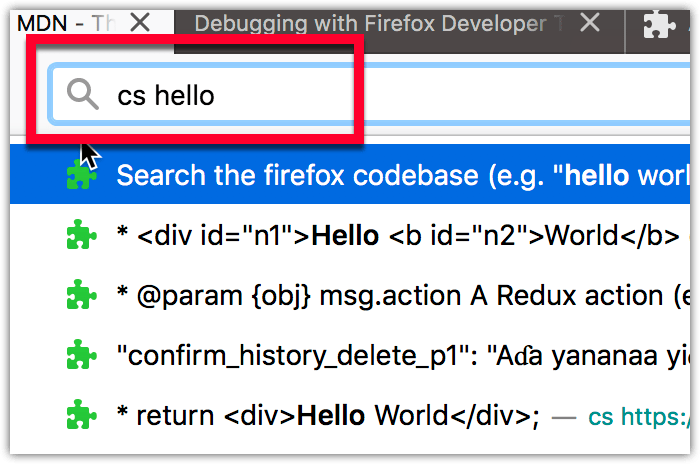
Example showing the result of the firefox_code_search WebExtension's customization of the address bar suggestions.

This enables your extension to, for example, search a library of free ebooks or, as in the example above, a repository of code examples.

Specifying the omnibox customization

You tell your extension that it is going to customize the address bar suggestions by including the omnibox key and definition of the trigger keyword in its manifest.json 文件:

  "omnibox": { "keyword" : "cs" }


In the extension's background JavaScript file, using  omnibox.setDefaultSuggestion() , you can optionally define the first suggestion to be displayed in the address bar drop-down. Use this to provide a hint on how to use the feature:

browser.omnibox.setDefaultSuggestion({
  description: `Search the firefox codebase
    (e.g. "hello world" | "path:omnibox.js onInputChanged")`
});


You can then add the code to provide the customized content by listening for omnibox.onInputStarted , which is dispatched when the user has typed the keyword and a space, and omnibox.onInputChanged , which is dispatched whenever the user updates the address bar entry. You can then populate the suggestions, in this case building a search of https://searchfox.org/mozilla-central using the term entered by the user:

browser.omnibox.onInputChanged.addListener((text, addSuggestions) => {
  let headers = new Headers({"Accept": "application/json"});
  let init = {method: 'GET', headers};
  let url = buildSearchURL(text);
  let request = new Request(url, init);
  fetch(request)
    .then(createSuggestionsFromResponse)
    .then(addSuggestions);
});


If the extension set a default suggestion using omnibox.setDefaultSuggestion() , then this will appear first in the drop-down.

The extension can then listen for the user clicking one of the suggestions, using omnibox.onInputEntered . If the default suggestion is clicked the user's custom term is returned, otherwise the suggestion's string is returned. This also passes information on the user's browser preferences for handling new links. In the code below the user's custom term is used to create a search, otherwise the suggested URL is opened:

browser.omnibox.onInputEntered.addListener((text, disposition) => {
  let url = text;
  if (!text.startsWith(SOURCE_URL)) {
    // Update the url if the user clicks on the default suggestion.
    url = `${SEARCH_URL}?q=${text}`;
  }
  switch (disposition) {
    case "currentTab":
      browser.tabs.update({url});
      break;
    case "newForegroundTab":
      browser.tabs.create({url});
      break;
    case "newBackgroundTab":
      browser.tabs.create({url, active: false});
      break;
  }
});


范例

webextensions-examples repository on GitHub includes the firefox-code-search example which customizes the search bar.

Found a problem with this page?

最后修改: , 由 MDN 贡献者

  1. 浏览器扩展名
  2. 快速入门
    1. What are extensions?
    2. Your first extension
    3. Your second extension
    4. Anatomy of an extension
    5. Example extensions
    6. What next?
  3. 概念
    1. Using the JavaScript APIs
    2. Content scripts
    3. Match patterns
    4. Working with files
    5. 国际化
    6. Content Security Policy
    7. Native messaging
    8. Differences between API implementations
    9. Chrome incompatibilities
  4. 用户界面
    1. 用户界面
    2. Toolbar button
    3. Address bar button
    4. Sidebars
    5. Context menu items
    6. Options page
    7. Extension pages
    8. Notifications
    9. Address bar suggestions
    10. Developer tools panels
  5. 如何
    1. Intercept HTTP requests
    2. Modify a web page
    3. Insert external content
    4. Share objects with page scripts
    5. Add a button to the toolbar
    6. Implement a settings page
    7. Work with the Tabs API
    8. Work with the Bookmarks API
    9. Work with the Cookies API
    10. Work with contextual identities
    11. Interact with the clipboard
    12. Build a cross-browser extension
  6. Firefox differentiators
  7. JavaScript API
    1. Browser support for JavaScript APIs
    2. alarms
    3. bookmarks
    4. browserAction
    5. browserSettings
    6. browsingData
    7. captivePortal
    8. clipboard
    9. 命令
    10. contentScripts
    11. contextualIdentities
    12. Cookie
    13. devtools
    14. dns
    15. downloads
    16. events
    17. extension
    18. extensionTypes
    19. find
    20. history
    21. i18n
    22. identity
    23. idle
    24. management
    25. menus
    26. notifications
    27. omnibox
    28. pageAction
    29. permissions
    30. pkcs11
    31. privacy
    32. proxy
    33. runtime
    34. search
    35. sessions
    36. sidebarAction
    37. storage
    38. tabs
    39. theme
    40. topSites
    41. 类型
    42. userScripts
    43. webNavigation
    44. webRequest
    45. windows
  8. Manifest keys
    1. 介绍
    1. 作者
    2. background
    3. browser_action
    4. browser_specific_settings
    5. chrome_settings_overrides
    6. chrome_url_overrides
    7. 命令
    8. content_scripts
    9. content_security_policy
    10. default_locale
    11. description
    12. developer
    13. devtools_page
    14. dictionaries
    15. externally_connectable
    16. homepage_url
    17. icons
    18. incognito
    19. manifest_version
    20. name
    21. offline_enabled
    22. omnibox
    23. optional_permissions
    24. options_page
    25. options_ui
    26. page_action
    27. permissions
    28. protocol_handlers
    29. short_name
    30. sidebar_action
    31. storage
    32. theme
    33. theme_experiment
    34. user_scripts
    35. version
    36. version_name
    37. web_accessible_resources
  9. Extension Workshop
    1. Develop
    2. Publish
    3. Manage
    4. Enterprise
  10. Contact us
  11. Channels
    1. Add-ons blog
    2. Add-ons forum
    3. Add-ons chat
